Tracked shipping to the Netherlands for just €3.99. Prices include 9% BTW. 

Ship to
Netherlands
0
  • argentina
  • chile
  • colombia
  • españa
  • méxico
  • perú
  • estados unidos
  • internacional

Select your country

Americas

Europe

Rest of the world

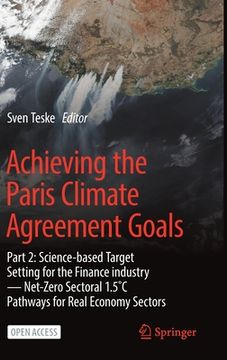
portada Achieving the Paris Climate Agreement Goals: Part 2: Science-Based Target Setting for the Finance Industry -- Net-Zero Sectoral 1.5˚c Pathways fo
Type
Physical Book
Publisher
Language
English
Pages
384
Format
Hardcover
Dimensions
23.4 x 15.6 x 2.5 cm
Weight
0.82 kg.
ISBN13
9783030991760

Achieving the Paris Climate Agreement Goals: Part 2: Science-Based Target Setting for the Finance Industry -- Net-Zero Sectoral 1.5˚c Pathways fo

Teske, Sven (Author) · Springer · Hardcover

Achieving the Paris Climate Agreement Goals: Part 2: Science-Based Target Setting for the Finance Industry -- Net-Zero Sectoral 1.5˚c Pathways fo - Teske, Sven

Cheaper New Book Imported to Netherlands
Delivery: 13 Jul - 16 Jul Shipping: 13 to 15 business days.
56,56 €
Faster New Book Imported to Netherlands
Delivery: 01 Jul - 03 Jul Shipping: 5 to 6 business days.
68,74 €
Import costs and 9% BTW included in the price ✅
56,56 €

Synopsis "Achieving the Paris Climate Agreement Goals: Part 2: Science-Based Target Setting for the Finance Industry -- Net-Zero Sectoral 1.5˚c Pathways fo"

This open access book is designed as a continuation of the editor's 2019 book Achieving the Paris Climate Agreement Goals. This volume provides an in-depth analysis of industry sectors globally, and its purpose is to present emission reduction targets in 5-year steps (2025 to 2050) for the main twelve finance sectors per the Global Industry Classification System. This scientific analysis aims to support the United Nations Principles for Responsible Investment initiative to give sustainability guidance for the global finance industry. The industry sector pathways presented here are based on the latest global and regional 100% renewable energy and non-energy greenhouse gas Representative Concentration Pathways in order to keep climate change significantly under +1.5 C and thereby achieve the Paris Climate Agreement goals. The heart of this book is three chapters presenting the results of industry scenario modelling. These chapters cover twelve industry and service sectors as well as transportation and buildings. The specific energy demand and specific emissions are presented based on the emission accounting concept of "Scope 1, Scope 2 and Scope 3" emission pathways. This methodology has been developed to measure the climate and sustainability index for companies, and this research project expands the methodology to apply it to entire industry sectors. The results presented here are the first overall industry assessments under Scope 1, 2 and 3 from 2020 through 2050. The base for the energy pathways is the scenarios scenarios published in the previous volume. The nonenergy GHG emission scenarios, broken down to agriculture & forestry and industry, are detailed and include all major greenhouse gases and aerosols. The final section of the book presents the main conclusions of the industry pathway development work and recommendations for the finance industry and policy makers. Additionally, future qualitative future investment requirements in specific technologies and measures are presented.Part 1 of this title can be found at this Link: https: //link.springer.com/book/10.1007/978-3-030-05843-2

Customers reviews

Frequently Asked Questions about the Book

All books in our catalog are Original.
The book is written in English.
The binding of this edition is Hardcover.

Questions and Answers about the Book

Do you have a question about the book? Login to be able to add your own question.

Opinions about Bookdelivery

More customer reviews