Hallo! Tracked shipping to Netherlands with Delivery Duty Paid for just €7 

Ship to
Netherlands
0
  • argentina
  • chile
  • colombia
  • españa
  • méxico
  • perú
  • estados unidos
  • internacional

Select your country

Americas

Europe

Rest of the world

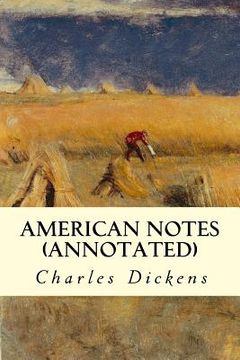
portada American Notes (annotated)
Type
Physical Book
Publisher
Language
English
Pages
290
Format
Paperback
Dimensions
22.9x15.2x1.5 cm
Weight
0.39 kg.
ISBN13
9781517365844

American Notes (annotated)

Charles Dickens (Author) · Createspace · Paperback

American Notes (annotated) - Charles Dickens

New Book Imported to Netherlands
Delivery: 28 Sep - 05 Oct Shipping: 16 to 20 business days.
€ 20,63
Import costs and 9% BTW included in the price ✅
€ 20,63

Synopsis "American Notes (annotated)"

American Notes for General Circulation is an American travelogue by Charles Dickens detailing his trip to North America from January to June 1842. Whilst there he acted as a critical observer of North American society, almost as if returning a status report on their progress. This can be compared to the style of his Pictures from Italy written four years later, where he wrote far more like a tourist. His American journey was also an inspiration for his novel Martin Chuzzlewit. Having arrived in Boston, he visited Lowell, New York, and Philadelphia, and travelled as far south as Richmond, as far west as St. Louis and as far north as Quebec. The American city he liked best was Boston - "the air was so clear, the houses were so bright and gay. [...] The city is a beautiful one, and cannot fail, I should imagine, to impress all strangers very favourably." Further, it was close to the Perkins Institution and Massachusetts Asylum for the Blind where Dickens encountered Laura Bridgman, who impressed him greatly. On 3 January 1842, one month shy of his 30th birthday, Dickens sailed with his wife, Catherine, and her maid, Anne Brown, from Liverpool on board the steamship RMS Britannia bound for America. Arriving in Boston on 22 January 1842, the author was at once mobbed. Dickens at first revelled in the attention, but soon the endless demands on his time began to wear on his enthusiasm. He complained in a letter to his friend John Forster: I can do nothing that I want to do, go nowhere where I want to go, and see nothing that I want to see. If I turn into the street, I am followed by a multitude. He travelled mainly on the East Coast and the Great Lakes area of both the United States and Canada, primarily by steamboat, but also by rail and coach. During his extensive itinerary, he made a particular point of visiting prisons and mental institutions and even took a quick glimpse at the prairie. He was particularly critical of the American press and the sanitary conditions of American cities. He also wrote merciless parodies of the manners of the locals, including, but not limited to, their rural conversations and practice of spitting tobacco in public (Ch. 8 - Washington): As Washington may be called the headquarters of tobacco-tinctured saliva, the time is come when I must confess, without any disguise, that the prevalence of those two odious practices of chewing and expectorating began about this time to be anything but agreeable, and soon became most offensive and sickening. In Washington, D.C., he called upon President John Tyler in the White House, writing that: ...he looked somewhat worn and anxious, and well he might; being at war with everybody - but the expression of his face was mild and pleasant, and his manner was remarkably unaffected, gentlemanly, and agreeable. I thought that in his whole carriage and demeanour, he became his station singularly well. Although generally impressed by what he found, he could not forgive the continued existence of slavery in the United States, and the final chapters of the book are devoted to a criticism of the practice. He was also unhappy about copyright issues. Dickens, by this time, had become an international celebrity, but owing to the lack of an international copyright law, bootleg copies of his works were freely available in North America and he could not abide losing money. Dickens called for international copyright law in many of his speeches in America, and his persistence in discussing the subject led some critics to accuse him of having traveled to America primarily to agitate for that cause. Dickens' letters home to his friends, including John Forster and illustrator Daniel Maclise, helped to form the basis of the book.
Charles Dickens
  (Author)
View Author's Page
Charles Dickens (February 7, 1812 - June 9, 1870) was born in Portsmouth and was the eldest son of a Royal Navy clerk. At twelve, his father's imprisonment for debt forced him to work in a blacking factory. His education was sporadic: he taught himself shorthand, worked as a clerk in a law office, and eventually became a parliamentary correspondent for the Morning Chronicle.

Coming from a humble family, "good old Charles" did not receive formal education until he was nine, and was heavily criticized by the critics of the time for being too self-taught. His life took an unexpected turn with his father's imprisonment for debts, moving his family to live with him in jail, allowed at that time by British laws. At the age of 12, he was already considered fit to start working in a dye factory. Although his family's situation had improved, his mother insisted he keep working there, inspiring him to write one of his masterpieces, David Copperfield.

His articles, later collected in Scenes from London Life by "Boz" (1836-1837), were very successful, and with the appearance in 1837 of The Posthumous Papers of the Pickwick Club, Dickens became a true publishing phenomenon. Novels such as Oliver Twist (1837-1839), Nicholas Nickleby (1838-1839), and Barnaby Rudge (1841) gained enormous popularity, as did some travel chronicles, such as Pictures from Italy (1846). With Dombey and Son (1846-1848) he began his mature period, of which good examples are David Copperfield (1849-1850), his first novel in the first person and his favorite, in which he developed some autobiographical episodes; Bleak House (1852-1853); Little Dorrit (1855-1857), A Tale of Two Cities (1859), Great Expectations (1860-1861), and Our Mutual Friend (1864-1865). He died at Gad's Hill, his country house in Higham, in the county of Kent.
See more
See less


Customers reviews

Frequently Asked Questions about the Book

All books in our catalog are Original.
The book is written in English.
The binding of this edition is Paperback.

Questions and Answers about the Book

Do you have a question about the book? Login to be able to add your own question.

Opinions about Bookdelivery

More customer reviews