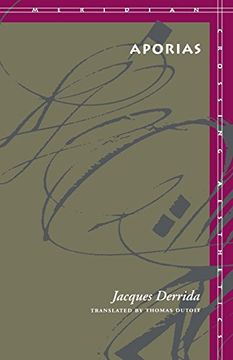
"My death--is it possible?" That is the question asked, explored, and analyzed in Jacques Derrida's new book. "Is my death possible?" How is this question to be understood? How and by whom can it be asked, can it be quoted, can it be an appropriate question, and can it be asked in the appropriate moment, the moment of "my death"? One of the aporetic experiences touched upon in this seminal essay is the impossible, yet unavoidable experience that "my death" can never subject to an experience that would be properly mine, that I can have, and account for, yet that there is, at the same time, nothing closer to me and more properly mine than "my death." This book bears a special significance because in it Derrida focuses on an issue that has informed the whole of his work up to the present. For the last thirty years, Derrida has repeatedly, in various contexts and various ways, broached the question of aporia. Making it his central concern here Derrida stakes out a new frontier, at which the debate with his work must take place from now on: the debate about the aporia between singularity and generality, about the national, linguistic, and cultural specificity of experience and the trans-national, trans-cultural law that protects this specificity of experience and of the necessity to continue working in the tradition of critique and of the idea of critique, yet the corresponding necessity to transcend it without compromising it; the aporetical obligation to host the foreigner and the alien and yet to respect him, her, or it as foreign. The foreign or the foreigner has always been considered a figure of death, and death a figure of the foreign. How this figure has been treated in the analytic of death in Heidegger's Being in Time is explored by Derrida in analytical tour de force that will not fail to set new standards for the discussion of Heidegger and for dealing with philosophical texts, with their limits and their aporias. The detailed discussion of the theoretical presuppositions of recent cultural histories of death (Ariès, for example) and of psychological theorizations of death (including Freud's) broaden the scope of Derrida's investigation and indicate the impact of the aporia of "my death" for any possible theory.
Jacques Derrida nació el 15 de julio de 1930 en El Biar, Argelia, y murió el 8 de octubre de 2004 en París, Francia. Proveniente de una familia judía sefardí en el contexto del colonialismo francés, su infancia estuvo marcada por acontecimientos que influirían en su sensibilidad filosófica: entre ellos, la experiencia de ser excluido de su liceo en 1942 debido a decretos antijudíos del régimen de Vichy. Posteriormente se trasladó a París para formarse en filosofía, y tras ejercer la enseñanza en la Sorbona y en la École Normale Supérieure, se consolidó como uno de los más influyentes filósofos del siglo XX.
Derrida es sobretodo conocido por haber desarrollado la filosofía de la deconstrucción, un método crítico que analiza cómo los textos, discursos o sistemas de pensamiento contienen oposiciones jerárquicas implícitas (como presencia/ausencia, palabra/escritura, naturaleza/cultura) y muestra cómo esas oposiciones pueden desplazarse o derrumbarse. Su trabajo influyó profundamente en áreas como filosofía, teoría literaria, lingüística, derecho, arquitectura y estudios culturales, sirviendo para cuestionar los fundamentos de la metafísica occidental.
Entre sus obras más destacadas se encuentran Of Grammatology (1967), Writing and Difference (1967) y Margins of Philosophy (1972). A lo largo de su vida académica, abordó temas como la escritura, la diferencia, la presencia, la identidad, la justicia, la memoria y la alteridad. Su estilo, complejo y frecuentemente polémico, generó tanto adhesiones como críticas intensas. Derrida deja un legado que sigue vivo en múltiples disciplinas, movilizando el pensamiento en torno a la apertura, el otro y el procedimiento crítico.
See more
See less
Customers reviews
Cristian Carmona Concha
Thursday, June 27, 2019
Verified Purchase
Llegó dentro del plazo estipulado!! Una nota, el libro está íntegramente en inglés