Hallo! Tracked shipping to Netherlands with Delivery Duty Paid for just €7 

Ship to
Netherlands
0
  • argentina
  • chile
  • colombia
  • españa
  • méxico
  • perú
  • estados unidos
  • internacional

Select your country

Americas

Europe

Rest of the world

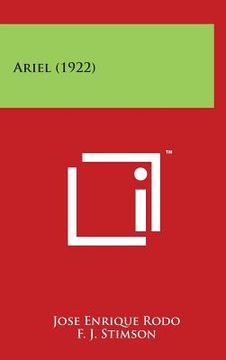
portada Ariel (1922)
Type
Physical Book
Language
English
Pages
172
Format
Hardcover
Dimensions
22.9x15.2x1.1 cm
Weight
0.40 kg.
ISBN13
9781169982192

Ariel (1922)

Jose Enrique Rodo (Author) · Literary Licensing, LLC · Hardcover

Ariel (1922) - Jose Enrique Rodo

New Book Imported to Netherlands
Delivery: 12 Oct - 19 Oct Shipping: 16 to 20 business days.
€ 52,34
Import costs and 9% BTW included in the price ✅
€ 52,34

Synopsis "Ariel (1922)"

Ariel is a philosophical essay written by the Uruguayan author Jose Enrique Rodo and published in 1922. The book is a reflection on the cultural identity of Latin America and the role of education in shaping that identity. The title is a reference to Shakespeare's character Ariel from The Tempest, who represents the imaginative and creative spirit of humanity. Rodo argues that Latin America must resist the influence of materialism and utilitarianism from Europe and instead embrace its own unique cultural values, which are rooted in idealism and spirituality. He believes that education should focus on cultivating these values and nurturing the individual's imagination and creativity. The book has been influential in shaping Latin American cultural and political thought and is considered a classic of Latin American literature.This Is A New Release Of The Original 1922 Edition.This scarce antiquarian book is a facsimile reprint of the old original and may contain some imperfections such as library marks and notations. Because we believe this work is culturally important, we have made it available as part of our commitment for protecting, preserving, and promoting the world's literature in affordable, high quality, modern editions, that are true to their original work.
Jose Enrique Rodo
  (Author)
View Author's Page
José Enrique Rodó (Montevideo, July 15, 1871 – Palermo, Italy, May 1, 1917) was a Uruguayan writer, essayist, and politician, noted as one of the most influential figures in Latin American literary modernism. His work is marked by a deep commitment to Hispanic American cultural identity and a critique of utilitarianism and the influence of Anglo-Saxon culture in the region

Son of José Rodó and Rosario Piñeyro, Rodó showed from an early age a great aptitude for reading and writing. At 14, after his father's death, he began working as an assistant in a notary's office. Despite not having completed his university studies, his literary talent allowed him to access the chair of Literature at the University of Montevideo in 1898

In 1900 he published his best-known work, Ariel, a philosophical essay that became a reference in Latin American thought. In it, he uses characters from Shakespeare's The Tempest—Prospero, Ariel, and Caliban—to represent values such as wisdom, idealism, and materialism, respectively. Through this symbolism, Rodó advocates for an education based on humanist values and a critique of the utilitarian materialism of North American culture

In addition to his literary work, Rodó was an active political and cultural figure. He founded in 1895 the National Review of Literature and Social Sciences and was a deputy of the Colorado Party between 1902 and 1907. His thought influenced movements such as the University Reform of 1918 and general Latin American cultural criticism

Rodó died in 1917 in Palermo, Italy, while serving as a correspondent for the Argentine magazine Caras y Caretas. His legacy endures in Latin American literature and thought, being considered one of the great thinkers and writers of the region
See more
See less


Customers reviews

Frequently Asked Questions about the Book

All books in our catalog are Original.
The book is written in English.
The binding of this edition is Hardcover.

Questions and Answers about the Book

Do you have a question about the book? Login to be able to add your own question.

Opinions about Bookdelivery

More customer reviews