Hallo! Tracked shipping to Netherlands with Delivery Duty Paid for just €7 

Ship to
Netherlands
0
  • argentina
  • chile
  • colombia
  • españa
  • méxico
  • perú
  • estados unidos
  • internacional

Select your country

Americas

Europe

Rest of the world

portada bees,lectures
bees,lecturesbees,lecturesbees,lectures
Type
Physical Book
Epilogue by
Introduction by
Publisher
Language
English
Pages
222
Format
Paperback
Dimensions
21.5x14x1.7 cm
Weight
0.34 kg.
ISBN
0880104570
ISBN13
9780880104579

bees,lectures

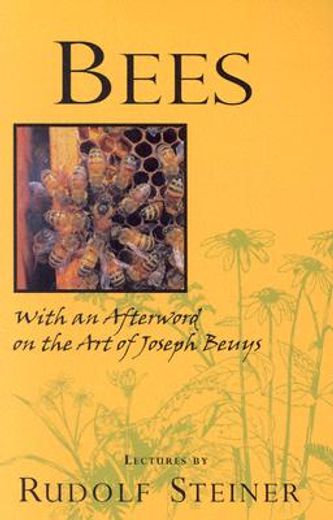
Rudolf Steiner (Author) · David Adams (Epilogue by) · Gunther Hauk (Introduction by) · Steiner Books · Paperback

bees,lectures - Steiner, Rudolf ; Hauk, Gunther ; Adams, David

Cheaper New Book Imported to Netherlands
Delivery: 28 Sep - 07 Oct Shipping: 12 to 18 business days.
€ 29,00
Faster New Book Imported to Netherlands
Delivery: 14 Sep - 16 Sep Shipping: 2 to 3 business days.
€ 30,32
Import costs and 9% BTW included in the price ✅
€ 29,00

Synopsis "bees,lectures"

8 Lectures in Dornach, Nov 26, 1923 to Dec 22, 1923 (CW 351) In 1923 Rudolf Steiner predicted the dire state of today's honeybee. He stated that, within fifty to eighty years, we would see the consequences of mechanizing the forces that had previously operated organically in the beehive. Such practices include breeding queen bees artificially. The fact that over sixty percent of the American honeybee population has died during the past ten years, and that this trend is continuing around the world, should make us aware of the importance of the issues discussed in these lectures. Steiner began this series of lectures on bees in response to a question from an audience of workers at the Goetheanum. From physical depictions of the daily activities of bees to the most elevated esoteric insights, these lectures describe the unconscious wisdom of the beehive and its connection to our experience of health, culture, and the cosmos. Bees is essential reading for anyone interested in understanding the true nature of the honeybee, as well as those who wish to heal the contemporary crisis of the beehive. Bees includes an essay by David Adams, "From Queen Bee to Social Sculpture: The Artistic Alchemy of Joseph Beuys." The art and social philosophy of Joseph Beuys (1921-1986) is among the most influential of the twentieth century. He was strongly influenced by Rudolf Steiner's lectures on bees. The elemental imagery and its relationship to human society played an important role in Beuys's sculptures, drawings, installations, and performance art. Adams' essay on Beuys adds a whole new dimension to these lectures, generally considered to be directed more specifically to biodynamic methods and beekeeping. C O N T E N T S Introduction by Gunther Hauk Eight Lectures by Rudolf SteinerBlackboard Drawings Appendix" Extracts from Various Lectures Afterword by David Adams: "From Queen Bee to Social Sculpture: The Artistic Alchemy of Joseph Beuys" Index This volume consists of 8 lectures (of 15) from Mensch und Welt. Das Wirken des Geistes in der Natur. Über das Wesen der Bienen (GA 351).
Rudolf Steiner
  (Author)
View Author's Page
Rudolf Steiner (Donji Kraljevec, Austro-Hungarian Empire, now Croatia, February 25 or 27, 1861-Dornach, Switzerland, March 30, 1925) was an Austrian philosopher, literary scholar, educator, artist, playwright, social thinker, and occultist. He was the founder of anthroposophy, Waldorf education, biodynamic agriculture, anthroposophic medicine, and the new artistic form of eurythmy.

He described anthroposophy as follows: Anthroposophy is a path of knowledge that would like to lead the spiritual in man to the spiritual in the universe. Those who feel certain questions about the essence of man and the world as a vital necessity as the one felt when we are hungry and thirsty can be anthroposophists.

Steiner proposed a form of ethical individualism, to which he later added a more explicitly spiritual component. He derived his epistemology from the worldview of Johann Wolfgang Goethe, according to which thought is an organ of perception just like the eye or the ear. Just as the eye perceives colors and the ear sounds, so thought perceives ideas.
See more
See less

Customers reviews

Frequently Asked Questions about the Book

All books in our catalog are Original.
The book is written in English.
The binding of this edition is Paperback.

Questions and Answers about the Book

Do you have a question about the book? Login to be able to add your own question.

Opinions about Bookdelivery

More customer reviews