Tracked shipping to the Netherlands for just € 7. Prices include 9% BTW and new EU € 3 customs duty. No hidden fees. 

Ship to
Netherlands
0
  • argentina
  • chile
  • colombia
  • españa
  • méxico
  • perú
  • estados unidos
  • internacional

Select your country

Americas

Europe

Rest of the world

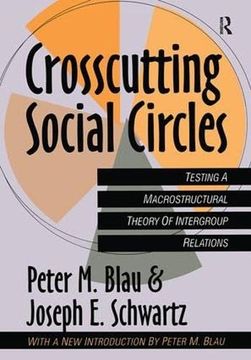
portada Crosscutting Social Circles: Testing a Macrostructural Theory of Intergroup Relations
Type
Physical Book
Publisher
Language
English
Pages
286
Format
Hardcover
Dimensions
25.7 x 18.3 x 2.3 cm
Weight
0.74 kg.
ISBN13
9781138521605

Crosscutting Social Circles: Testing a Macrostructural Theory of Intergroup Relations

Joseph Schwartz (Author) · Peter Blau (Author) · Routledge · Hardcover

Crosscutting Social Circles: Testing a Macrostructural Theory of Intergroup Relations - Blau, Peter ; Schwartz, Joseph

Cheaper New Book Imported to Netherlands
Delivery: 14 Aug - 21 Aug Shipping: 19 to 23 business days.
167,05 €
Faster New Book Imported to Netherlands
Delivery: 05 Aug - 10 Aug Shipping: 12 to 14 business days.
233,53 €
Import costs and 9% BTW included in the price ✅
167,05 €

Synopsis "Crosscutting Social Circles: Testing a Macrostructural Theory of Intergroup Relations"

Crosscutting Social Circles describes a theory of groups' relations to each other, and tests the theory in the 125 largest metropolitan areas In the United States. The focus is on the Influence social structure exerts on intergroup relations. Blau and Schwartz show how role relations are influenced by how people are distributed among social positions. Examples are a community's racial composition, division of labor, ethnic heterogeneity, income Inequality, or the extent to which educational differences are related to income differences. Blau and Schwartz test their theory by considering its impact on such structural conditions as intermarriage, an important form of intergroup relations.The authors derive the main principles of previously formulated theories of intergroup relations and present them in simpler and clearer form. They empirically test the power of the theory by analyzing its ability to predict how social structure affects intermarriage in the largest American cities, where three-fifths of the American population live. They selected cities because population distribution of a small neighborhood might be affected by casual associations among neighbors; it is much more sociologically interesting if population distribution also affects mate selection in a city of millions.Unlike most theories that emphasize the implications of such cultural orientations as shared values and common norms, this volume focuses on the significance of various forms of inequality and heterogeneity. As one of the few books that supplies a large-scale empirical test of implications of a theory, Crosscutting Social Circles serves as a model. The new introduction by Peter Blau reviews the origins and impact of the book. It will be of immense value to sociologists, psychologists, and group relations specialists.

Customers reviews

Frequently Asked Questions about the Book

All books in our catalog are Original.
The book is written in English.
The binding of this edition is Hardcover.

Questions and Answers about the Book

Do you have a question about the book? Login to be able to add your own question.

Opinions about Bookdelivery

More customer reviews