Hallo! Tracked shipping to Netherlands with Delivery Duty Paid for just €7 

Ship to
Netherlands
0
  • argentina
  • chile
  • colombia
  • españa
  • méxico
  • perú
  • estados unidos
  • internacional

Select your country

Americas

Europe

Rest of the world

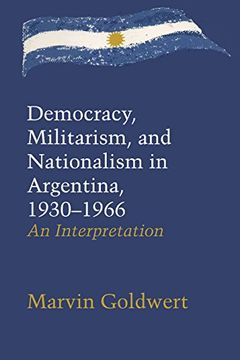
portada Democracy, Militarism, and Nationalism in Argentina, 1930-1966: An Interpretation: 25 (Llilas Latin American Monograph Series)
Type
Physical Book
Year
1972
Language
English
Pages
274
Format
Paperback
ISBN13
9781477301845

Democracy, Militarism, and Nationalism in Argentina, 1930-1966: An Interpretation: 25 (Llilas Latin American Monograph Series)

Sidney Goldwert (Author) · University Of Texas Press · Paperback

Democracy, Militarism, and Nationalism in Argentina, 1930-1966: An Interpretation: 25 (Llilas Latin American Monograph Series) - Sidney Goldwert

New Book Imported to Netherlands
Delivery: 17 Aug - 19 Aug Shipping: 3 to 4 business days.
€ 38,78
Import costs and 9% BTW included in the price ✅
€ 38,78

Synopsis "Democracy, Militarism, and Nationalism in Argentina, 1930-1966: An Interpretation: 25 (Llilas Latin American Monograph Series) "

Until 1930, Argentina was one of the great hopes for stable democracy in Latin America. Argentines themselves believed in the destiny of their nation to become the leading Latin American country in wealth, power, and culture. But the revolution of 1930 unleashed the scourges of modern militarism and chronic instability in the land. Between 1930 and 1966, the Argentine armed forces, or factions of the armed forces, overthrew the government five times. For several decades, militarism was the central problem in Argentine political life. In this study, Marvin Goldwert interprets the rise, growth, and development of militarism in Argentina from 1930 to 1966. The tortuous course of Argentine militarism is explained through an integrating hypothesis. The army is viewed as a “power factor,” torn by a permanent dichotomy of values, which rendered it incapable of bringing modernization to Argentina. Caught between conflicting drives for social order and modernization, the army was an ambivalent force for change. First frustrated by incompetent politicians (1916–1943), the army was later driven by Colonel Juan D. Perón into an uneasy alliance with labor (1943–1955). Peronism initially represented the means by which army officers could have their cake―nationalistic modernization―and still eat it in peace, with the masses organized in captive unions tied to an authoritarian state. After 1955, when Perón was overthrown, a deeply divided army struggled to contain the remnants of its own dictatorial creation. In 1966, the army, dedicated to staunch anti-Peronism, again seized the state and revived the dream of reconciling social order and modernization through military rule. Although militarism has been a central problem in Argentine political life, it is also the fever that suggests deeper maladies in the body politic. Marvin Goldwert seeks to relate developments in the military to the larger political, social, and economic developments in Argentine history. The army and its factions are viewed as integral parts of the whole political spectrum during the period under study.

Customers reviews

Frequently Asked Questions about the Book

All books in our catalog are Original.
The book is written in English.
The binding of this edition is Paperback.

Questions and Answers about the Book

Do you have a question about the book? Login to be able to add your own question.

Opinions about Bookdelivery

More customer reviews