Hallo! Tracked shipping to Netherlands with Delivery Duty Paid for just €7 

Ship to
Netherlands
0
  • argentina
  • chile
  • colombia
  • españa
  • méxico
  • perú
  • estados unidos
  • internacional

Select your country

Americas

Europe

Rest of the world

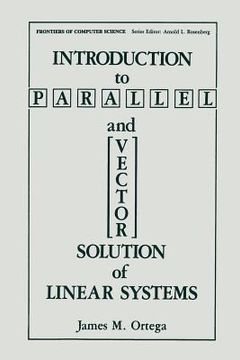
portada Introduction to Parallel and Vector Solution of Linear Systems
Type
Physical Book
Publisher
Language
English
Pages
305
Format
Paperback
Dimensions
23.4x15.6x1.7 cm
Weight
0.45 kg.
ISBN13
9781489921147

Introduction to Parallel and Vector Solution of Linear Systems

James M. Ortega (Author) · Springer · Paperback

Introduction to Parallel and Vector Solution of Linear Systems - Ortega, James M.

Cheaper New Book Imported to Netherlands
Delivery: 25 Sep - 02 Oct Shipping: 13 to 17 business days.
€ 145,88
Faster New Book Imported to Netherlands
Delivery: 16 Sep - 18 Sep Shipping: 6 to 7 business days.
€ 192,59
Import costs and 9% BTW included in the price ✅
€ 145,88

Synopsis "Introduction to Parallel and Vector Solution of Linear Systems"

Although the origins of parallel computing go back to the last century, it was only in the 1970s that parallel and vector computers became available to the scientific community. The first of these machines-the 64 processor llliac IV and the vector computers built by Texas Instruments, Control Data Corporation, and then CRA Y Research Corporation-had a somewhat limited impact. They were few in number and available mostly to workers in a few government laboratories. By now, however, the trickle has become a flood. There are over 200 large-scale vector computers now installed, not only in government laboratories but also in universities and in an increasing diversity of industries. Moreover, the National Science Foundation's Super- computing Centers have made large vector computers widely available to the academic community. In addition, smaller, very cost-effective vector computers are being manufactured by a number of companies. Parallelism in computers has also progressed rapidly. The largest super- computers now consist of several vector processors working in parallel. Although the number of processors in such machines is still relatively small (up to 8), it is expected that an increasing number of processors will be added in the near future (to a total of 16 or 32). Moreover, there are a myriad of research projects to build machines with hundreds, thousands, or even more processors. Indeed, several companies are now selling parallel machines, some with as many as hundreds, or even tens of thousands, of processors.

Customers reviews

Frequently Asked Questions about the Book

All books in our catalog are Original.
The book is written in English.
The binding of this edition is Paperback.

Questions and Answers about the Book

Do you have a question about the book? Login to be able to add your own question.

Opinions about Bookdelivery

More customer reviews