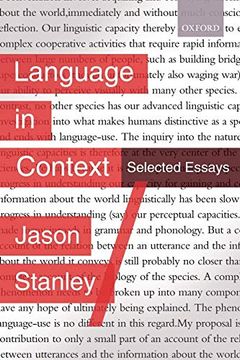
Natural languages all contain constructions the interpretation of which depends upon the situation in which they are used. In Language and Context, Jason Stanley presents a series of essays which develop a theory of how the situation in which we speak interacts with the words we use to help produce what we say. The reason we can so smoothly operate with sentences that can be used to express very different items of information, Stanley argues, is that there are linguistically mandated constraints on the effects of the situation on what we say. These linguistically mandated constraints are most evident in the cases of sentences containing explicit pronouns, such as 'She is a mathematician', where interpretation of the information expressed is guided by the use of the pronoun 'she'. But even when such explicit pronouns are lacking, our sentences provide similar cues to allow our interlocutors to determine the information expressed. We are, in the main, confident that our interlocutors will smoothly grasp what we say, because the grammar and meaning of our sentences encodes these constraints. In defending this theory, Stanley pays close attention to specific cases of context-sensitive constructions, such as quantified noun phrases, comparative adjectives, and conditionals. Philosophers and cognitive scientist have appealed to the dependence of what is intuitively said by a sentence on the situation in which it is uttered to argue against the possibility of a systematic theory of meaning for natural language. The theory developed in this book is a vigorous defence of the possibility of a systematic theory of meaning for natural language against these influential tendencies.
El padre de Jason Stanley escapó de la Alemania nazi por el aeropuerto berlinés de Tempelhof cuando tenía solo seis años. Llegó a Nueva York un 3 de julio de 1939. La familia aún conserva un álbum familiar con las fotografías de la Estatua de la Libertad, así que Stanley, nacido en 1969, creció con las historias de su país, Estados Unidos, como la nación más heroica. A pesar de ello, o precisamente por eso, ha dedicado años al estudio de los mecanismos que emplea el fascismo para convencer a la gente, especialmente ahora y en su país. Desde 2013 es profesor de filosofía en la Universidad de Yale, después de haberlo sido en la de Rutgers, pero son las dos últimas etapas de una larga y brillante carrera académica, que lo llevó a estudiar a Alemania en 1985 y, después del doctorado, a Oxford, en Inglaterra. Especializado en filosofía del lenguaje, ha publicado títulos como Know How, Languages in Context o Knowledge and Practical Interests, que ganó en 2007 el premio de filosofía de la Asociación de editores americana. También se alzó en 2005 con el máximo galardón de la Asociación americana de filósofos, que premia a un solo filósofo al año. Escribe regularmente en The Washington Post, The Boston Review o The New York Times, donde ha alimentado el popular blog filosófico The Stone. De allí surgieron textos para libros como How Propaganda Works. How Fascism Works, que hemos traducido como Facha, es su último y más esperado trabajo. Un éxito instantáneo de crítica y lectores. Y una valiosa herramienta para saber leer la alarmante deriva autoritaria de nuestro mundo.