
Ship to
Netherlands
Select your location
Shipping costs will be calculated based on this address throughout the site.
Shipping costs will be calculated based on this address throughout the site.
Select your country
Americas
Argentina
Brazil
Canada
Chile
Colombia
Costa Rica
Dominican Republic
Ecuador
El Salvador
Mexico
Peru
U.S.A.
Uruguay
Europe
Austria
Belgium
Croatia
Czech Republic
Denmark
Finland
France
Germany
Greece
Hungary
Ireland
Italy
Latvia
Malta
Netherlands
Norway
Poland
Portugal
Serbia
Slovakia
Slovenia
Spain
Sweden
Switzerland
United Kingdom
Rest of the world
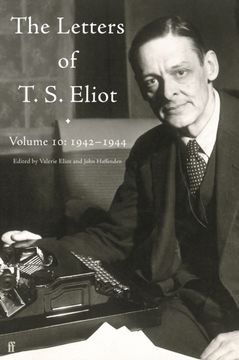
Letters of T. S. Eliot Volume 10: 1942–1944
T. S. Eliot
Letters of T. S. Eliot Volume 10: 1942–1944
T. S. Eliot (Author) · Faber and Faber · Hardcover
Letters of T. S. Eliot Volume 10: 1942–1944
T. S. Eliot
‘What is accomplished by this sort of cultural warfare is impossible to say: but it [is] a part of total warfare which one must, as an individual, accept one’s part in.’
At the height of the Second World War, T. S. Eliot commits himself to fighting for the cultural values of Europe. He goes on a lecture tour of Sweden; he writes talks for the BBC; he reads poems for the Czechoslovak Centre, for ‘Aid to Russia’ and for the ‘French in Britain Fund’. He lectures on ‘The Music of Poetry’ in Glasgow; addresses the Classical Association; talks at the ‘Moot’, and visits organisations including the Anglo-Swedish Society and the British-Norwegian Institute; and he works for the Christian News-Letter. He serves as President of the English Circle of ‘Books Across the Sea’ and as first President of the Virgil Society. He feels exhausted by travel and performance but remains stalwart. And always there is the threat in London – he has ‘no regular habitation’ – of being bombed: ‘I have taken . . . to sleeping in my teeth.’
Contacts and correspondents during these dark days include the film director George Hollering for whom he struggles to adapt his play Murder in the Cathedral, Kenneth Clark, Henry Moore, David Jones, William Empson, Mary Trevelyan, Karl Mannheim, Louis MacNeice, Elizabeth Bowen, M. J. Tambimuttu, Edith Sitwell and Reinhold Niebuhr. Notable poets recruited to the Faber fold include Lawrence Durrell, Anne Ridler and Norman Nicholson.
Eliot’s own creative energies are focused on completing Little Gidding, the final poem of the supernal sequence Four Quartets. The series of letters to John Hayward, who advises him, is a tour de force of the art: full of news, merriment and mischief.
Do you have a question about the book? Login to be able to add your own question.