Hallo! Tracked shipping to Netherlands with Delivery Duty Paid for just €7 

Ship to
Netherlands
0
  • argentina
  • chile
  • colombia
  • españa
  • méxico
  • perú
  • estados unidos
  • internacional

Select your country

Americas

Europe

Rest of the world

portada Machine Learning Under Resource Constraints - Discovery in Physics
Type
Physical Book
Publisher
Language
English
Pages
363
Format
Paperback
ISBN13
9783110785951

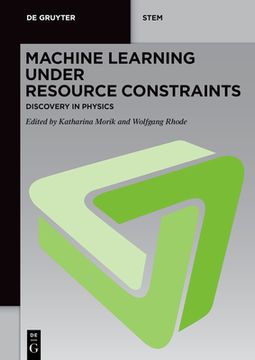
Machine Learning Under Resource Constraints - Discovery in Physics

Katharina Morik (Illustrated by) · Wolfgang Rhode (Illustrated by) · de Gruyter · Paperback

Machine Learning Under Resource Constraints - Discovery in Physics - Morik, Katharina ; Rhode, Wolfgang

Cheaper New Book Imported to Netherlands
Delivery: 17 Sep - 21 Sep Shipping: 8 to 9 business days.
€ 73,87
Faster New Book Imported to Netherlands
Delivery: 09 Sep - 11 Sep Shipping: 2 to 3 business days.
€ 118,43
Import costs and 9% BTW included in the price ✅
€ 73,87

Synopsis "Machine Learning Under Resource Constraints - Discovery in Physics "

Machine Learning under Resource Constraints addresses novel machine learning algorithms that are challenged by high-throughput data, by high dimensions, or by complex structures of the data in three volumes. Resource constraints are given by the relation between the demands for processing the data and the capacity of the computing machinery. The resources are runtime, memory, communication, and energy. Hence, modern computer architectures play a significant role. Novel machine learning algorithms are optimized with regard to minimal resource consumption. Moreover, learned predictions are executed on diverse architectures to save resources. It provides a comprehensive overview of the novel approaches to machine learning research that consider resource constraints, as well as the application of the described methods in various domains of science and engineering. Volume 2 covers machine learning for knowledge discovery in particle and astroparticle physics. Their instruments, e.g., particle detectors or telescopes, gather petabytes of data. Here, machine learning is necessary not only to process the vast amounts of data and to detect the relevant examples efficiently, but also as part of the knowledge discovery process itself. The physical knowledge is encoded in simulations that are used to train the machine learning models. At the same time, the interpretation of the learned models serves to expand the physical knowledge. This results in a cycle of theory enhancement supported by machine learning.

Customers reviews

Frequently Asked Questions about the Book

All books in our catalog are Original.
The book is written in English.
The binding of this edition is Paperback.

Questions and Answers about the Book

Do you have a question about the book? Login to be able to add your own question.

Opinions about Bookdelivery

More customer reviews