Hallo! Tracked shipping to Netherlands with Delivery Duty Paid for just €7 

Ship to
Netherlands
0
  • argentina
  • chile
  • colombia
  • españa
  • méxico
  • perú
  • estados unidos
  • internacional

Select your country

Americas

Europe

Rest of the world

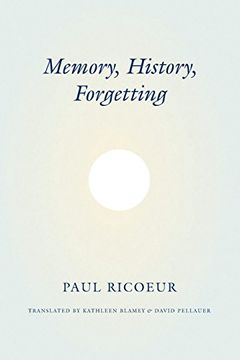
portada Memory, History, Forgetting
Type
Physical Book
Year
2006
Language
English
Pages
660
Format
Paperback
Weight
2
ISBN
0226713423
ISBN13
9780226713427

Memory, History, Forgetting

Paul Ricoeur (Author) · University Of Chicago Press · Paperback

Memory, History, Forgetting - Paul Ricoeur

New Book Imported to Netherlands
Delivery: 27 Aug - 01 Sep Shipping: 2 to 3 business days.
€ 44,67
Import costs and 9% BTW included in the price ✅
€ 44,67

Synopsis "Memory, History, Forgetting "

Why do major historical events such as the Holocaust occupy the forefront of the collective consciousness, while profound moments such as the Armenian genocide, the McCarthy era, and France's role in North Africa stand distantly behind? Is it possible that history "overly remembers" some events at the expense of others? A landmark work in philosophy, Paul Ricoeur's Memory, History, Forgetting examines this reciprocal relationship between remembering and forgetting, showing how it affects both the perception of historical experience and the production of historical narrative. Memory, History, Forgetting, like its title, is divided into three major sections. Ricoeur first takes a phenomenological approach to memory and mnemonical devices. The underlying question here is how a memory of present can be of something absent, the past. The second section addresses recent work by historians by reopening the question of the nature and truth of historical knowledge. Ricoeur explores whether historians, who can write a history of memory, can truly break with all dependence on memory, including memories that resist representation. The third and final section is a profound meditation on the necessity of forgetting as a condition for the possibility of remembering, and whether there can be something like happy forgetting in parallel to happy memory. Throughout the book there are careful and close readings of the texts of Aristotle and Plato, of Descartes and Kant, and of Halbwachs and Pierre Nora. A momentous achievement in the career of one of the most significant philosophers of our age, Memory, History, Forgetting provides the crucial link between Ricoeur's Time and Narrative and Oneself as Another and his recent reflections on ethics and the problems of responsibility and representation. “His success in revealing the internal relations between recalling and forgetting, and how this dynamic becomes problematic in light of events once present but now past, will inspire academic dialogue and response but also holds great appeal to educated general readers in search of both method for and insight from considering the ethical ramifications of modern events. . . . It is indeed a master work, not only in Ricoeur’s own vita but also in contemporary European philosophy.”—Library Journal “Ricoeur writes the best kind of philosophy—critical, economical, and clear.”— New York Times Book Review
Paul Ricoeur
  (Author)
View Author's Page
Paul Ricoeur (Valence, France, 1913 – Châtenay-Malabry, 2005) was a French philosopher known for his phenomenological-hermeneutic approach, integrating currents such as existentialism, psychoanalysis, and analytic philosophy. He developed his academic career at institutions like the universities of Strasbourg, the Sorbonne, Nanterre, and Chicago. His work focuses on the interpretation of time, identity, and memory, addressing fundamental questions about the human condition and historical narrative.

Among his most notable works are Time and Narrative (1983-1985), Oneself as Another (1990), and Memory, History, Forgetting (2000). These works explore the relationship between temporal experience, personal identity, and the representation of the past, significantly contributing to contemporary philosophy. Ricoeur received numerous accolades throughout his career, including the Balzan Prize for Philosophy in 2004.
See more
See less

Customers reviews

Frequently Asked Questions about the Book

All books in our catalog are Original.
The book is written in English.
The binding of this edition is Paperback.

Questions and Answers about the Book

Do you have a question about the book? Login to be able to add your own question.

Opinions about Bookdelivery

More customer reviews