Tracked shipping to the Netherlands for just €3.99. Prices include 9% BTW. 

Ship to
Netherlands
0
  • argentina
  • chile
  • colombia
  • españa
  • méxico
  • perú
  • estados unidos
  • internacional

Select your country

Americas

Europe

Rest of the world

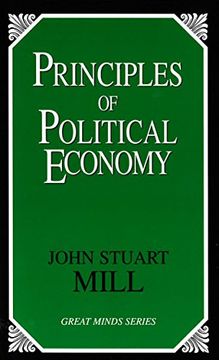
portada Principles of Political Economy (Great Minds)
Type
Physical Book
Year
2004
Language
English
Pages
710
Format
Paperback
Dimensions
21.1 x 13.8 x 3.8 cm
Weight
0.83 kg.
ISBN
1591021510
ISBN13
9781591021513

Principles of Political Economy (Great Minds)

John Stuart Mill (Author) · Prometheus Books · Paperback

Principles of Political Economy (Great Minds) - John Stuart Mill

Cheaper New Book Imported to Netherlands
Delivery: 06 Jul - 08 Jul Shipping: 8 to 9 business days.
37,10 €
Faster New Book Imported to Netherlands
Delivery: 01 Jul - 03 Jul Shipping: 5 to 6 business days.
39,88 €
Import costs and 9% BTW included in the price ✅
37,10 €

Synopsis "Principles of Political Economy (Great Minds) "

The standard economics textbook for more than a generation, John Stuart Mill's Principles of Political Economy (1848) was really as much a synthesis of his predecessors' ideas as it was an original economic treatise. Heavily influenced by the work of David Ricardo, and also taking ideas from Adam Smith and Thomas Malthus, Mill systematically demonstrated how important economic concepts could be applied to real-world situations. In his emphasis on realism, Mill thus took economics out of the realm of the abstract and placed it squarely within the context of society. For instance, he made a convincing case that wages, rent, and profit are not necessarily the expression of immutable laws that are independent of society. Rather, they are in actuality the results of social institutions and as such can be changed if the members of a society move to break traditional institutional habits. Reflecting his utilitarian social philosophy, Mill suggested that social improvements are always possible. He thus proposed modifying a purely laissez faire system, advocating trade protectionism and regulation of employees' work hours for the benefit of domestic industries and workers' well-being. In such features he displayed a leaning toward socialism. In summing up his objective for this massive work, Mill said later in his Autobiography (1873) that he wished "to unite the greatest individual liberty of action, with a common ownership in the raw material of the globe, and an equal participation of all in the benefits of combined labour." For anyone with an interest in the history of economics or the history of ideas, this landmark work of classical economics makes for stimulating and in many respects still very relevant reading.
John Stuart Mill
  (Author)
View Author's Page
John Stuart Mill (1806-1873) was a British philosopher, economist, and politician, considered a key figure in liberalism and utilitarianism. Influenced by Jeremy Bentham and his father, James Mill, he wrote extensively on freedom, economy, and social justice. Among his most notable works are On Liberty (1859), where he defends individual rights against state control, and Utilitarianism (1863), where he develops this philosophical current.

His work also covered political economy with Principles of Political Economy (1848) and the philosophy of law with Representative Government (1861). Additionally, in The Subjection of Women (1869) he advocated for gender equality. His thinking continues to influence contemporary political philosophy and social theory.
See more
See less

Customers reviews

Frequently Asked Questions about the Book

All books in our catalog are Original.
The book is written in English.
The binding of this edition is Paperback.

Questions and Answers about the Book

Do you have a question about the book? Login to be able to add your own question.

Opinions about Bookdelivery

More customer reviews