Hallo! Tracked shipping to Netherlands with Delivery Duty Paid for just €7 

Ship to
Netherlands
0
  • argentina
  • chile
  • colombia
  • españa
  • méxico
  • perú
  • estados unidos
  • internacional

Select your country

Americas

Europe

Rest of the world

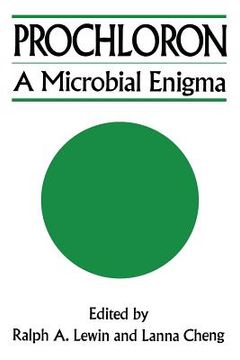
portada Prochloron: A Microbial Enigma
Type
Physical Book
Publisher
Language
English
Pages
130
Format
Paperback
Dimensions
22.9x15.2x1 cm
Weight
0.25 kg.
ISBN13
9781461282037

Prochloron: A Microbial Enigma

Lewin, Ralph A. (Author) · Springer · Paperback

Prochloron: A Microbial Enigma - Lewin, Ralph A.

Cheaper New Book Imported to Netherlands
Delivery: 06 Oct - 13 Oct Shipping: 12 to 16 business days.
€ 53,72
Faster New Book Imported to Netherlands
Delivery: 25 Sep - 29 Sep Shipping: 5 to 6 business days.
€ 69,09
Import costs and 9% BTW included in the price ✅
€ 53,72

Synopsis "Prochloron: A Microbial Enigma"

Ralph A. LewiQand Lanna Cheng In physics, the discovery of new (more properly, hitherto undetected) particles has often resulted from a search: like the discovery of America, their existence had been postulated but their actual existence awaited confirmation. In biology, new discoveries are rarely made in this way. The existence of an alga like Prochloron, as a putative ancestor of chloro- plasts, had been postulated, but in fact its discovery was a consequence of fortuitous events. Green algal symbionts in didemnid ascidians had been known for decades to a few marine zoologists who had worked in coral reef areas, but nobody had bothered much about them. When we happened to find them, under boulders on a seashore in Baja California, Mexico, where we were taking part in a student expedition, we didn't bother much either at first, though they worried us a little. With our portable microscope we could see no nuclei in the cells, which, according to the dogma accepted at the time, indicated that they were blue-green algae-yet they didn't look blue-green. They were leaf-green, like green algae and higher plants. We made desultory attempts to grow them in culture, in variously enriched seawater media, but failed. (This proved to be a frustrating experience, all too frequently repeated on subsequent expeditions. ) We collected enough for electron microscopy, though, and transmission electron microscopy (TEM) studies indicated that the cells were unequivocally prokaryotic.

Customers reviews

Frequently Asked Questions about the Book

All books in our catalog are Original.
The book is written in English.
The binding of this edition is Paperback.

Questions and Answers about the Book

Do you have a question about the book? Login to be able to add your own question.

Opinions about Bookdelivery

More customer reviews