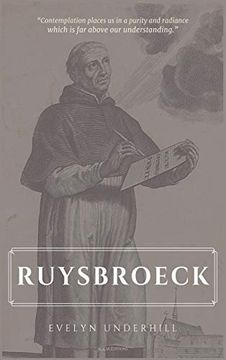
Evelyn Underhill was one of the greatest spiritual writers of the twentieth century. For her, true mysticism is, first of all, active and practical, an organic life process in which the whole self is engaged, rather than simply an intellectual apprehension. Jan van Ruysbroeck is thought to be the greatest of all the medieval Catholic mystics. Evelyn Underhill is, therefore, doing lovers not only of Catholic mysticism, but also of mysticism in general, a very real service by her monograph, which deals more satisfactorily than any existing work in English with the life and teachings of one of the most spiritual minds in Christendom. Her book is not simply a painstaking summary of the more patent generalities of the subject, but rather a deeply sympathetic entering into the mind of Ruysbroeck, and that, too, with no common insight.This edition contains a bibliographical note and complete footnotes.Excerpt: "In the history of the spiritual adventures of man, we find at intervals certain great mystics, who appear to gather up and fuse together in the crucible of the heart the diverse tendencies of those who have preceded them, and, adding to these elements the tincture of their own rich experience, give to us an intensely personal, yet universal, vision of God and man. These are constructive spirits, whose creations in the spiritual sphere sum up and represent the best achievement of a whole epoch; as in other spheres the great artist, musician, or poet-always the child of tradition as well as of inspiration-may do.John Ruysbroeck is such a mystic as this. His career, which covers the greater part of the fourteenth century-that golden age of Christian mysticism-seems to exhibit within the circle of a single personality, and carry up to a higher term than ever before, all the best attainments of the Middle Ages in the realm of Eternal Life. Rooted firmly in history, faithful to the teachings of the great Catholic mystics of the primitive and mediæval times, Ruysbroeck does not merely transmit, but transfigures, their principles: making from the salt, sulphur, and mercury of their vision, reason, and love, a new and living jewel-or, in his own words, a 'sparkling stone'-which reflects the actual radiance of the Uncreated Light. Absorbing from the rich soil of the Middle Ages all the intellectual nourishment which he needs, dependent too, as all real greatness is, on the human environment in which he grows-that mysterious interaction and inter-penetration of personalities without which human consciousness can never develop its full powers-he towers up from the social and intellectual circumstances that conditioned him: a living, growing, unique and creative individual, yet truly a part of the earth from which he springs."
Nació en Wolverhampton, Inglaterra, en 1875. Recibió una esmerada educación privada y asistió al King´s College para mujeres (Londres), donde estudió letras, historia, botánica y filosofía. Crecida en el agnosticismo, en 1907, durante una breve estancia en un convento franciscano, tiene lugar su conversión espiritual. A pesar de estar convencida de que la religión católica era la verdadera, diversas circunstancias impiden su adhesión a la Iglesia católica, y en 1921 optará finalmente por una pertenencia practicante al anglicanismo. En 1911, a raíz de la preparación y publicación de su obra fundamental La mística, conoce al barón Friedrich von Hügel, al que convertirá en su director espiritual; él influirá grandemente en su pensamiento y en su práctica religiosa. Repartió su actividad entre la escritura y la vida de devoción, asumiendo la dirección de retiros e impartiendo charlas y conferencias, dedicaciones que harán de ella unas de las maestras espirituales más importantes de su tiempo.
Autora de tres novelas y dos libros de poemas, destacan sus trabajos sobre mística y espiritualidad, que comprenden ediciones y comentarios de místicos y obras clásicas como Ruysbroeck, Walter Hilton, La Nube del no Saber o La Escala de Perfección. Entre sus numerosos libros cabe mencionar The Mystic Way: A Psychological Study in Christian Origins (1913), The Life of the Spirit and the Life of Today (1922), The Mystics of the Church (1925), Worship (1936), La práctica del misticismo (2015) y La mística (2ª edición en 2016), publicados en esta editorial.