Ship to
Netherlands
0
  • argentina
  • chile
  • colombia
  • españa
  • méxico
  • perú
  • estados unidos
  • internacional

Select your country

Americas

Europe

Rest of the world

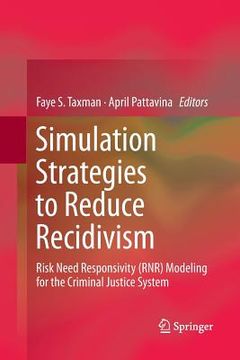
portada Simulation Strategies to Reduce Recidivism: Risk Need Responsivity (Rnr) Modeling for the Criminal Justice System
Type
Physical Book
Publisher
Language
English
Pages
315
Format
Paperback
Dimensions
23.4 x 15.6 x 1.8 cm
Weight
0.46 kg.
ISBN13
9781493902057

Simulation Strategies to Reduce Recidivism: Risk Need Responsivity (Rnr) Modeling for the Criminal Justice System

Taxman, Faye S. ; Pattavina, April (Author) · Springer · Paperback

Simulation Strategies to Reduce Recidivism: Risk Need Responsivity (Rnr) Modeling for the Criminal Justice System - Taxman, Faye S. ; Pattavina, April

Cheaper New Book Imported to Netherlands
Delivery: 18 Aug - 25 Aug Shipping: 12 to 16 business days.
99,53 €
Faster New Book Imported to Netherlands
Delivery: 06 Aug - 10 Aug Shipping: 4 to 5 business days.
135,09 €
Import costs and 9% BTW included in the price ✅
99,53 €

Synopsis "Simulation Strategies to Reduce Recidivism: Risk Need Responsivity (Rnr) Modeling for the Criminal Justice System"

The use of simulation modeling in criminal justice dates back to the 1970s. Early models were developed to capture the realities of the criminal justice system, to identify what changes were needed, and how small changes would affect the overall picture. Significant time and effort were devoted to these projects and although they achieved some success, the complex nature of the criminal justice system and the difficulties associated with improving and maintaining the models prohibited wide spread adoption in the field. Some of the problems with early simulation projects were the lack of data to validate models, the lack of technical skills needed by staff to design and build the models, and the technical difficulties with software programming to transform models into computerized representations.As simulation modeling has becoming a more popular technique across many disciplines, and technology as well as the technical skills of researchers has improved, this book revisits the concept of simulation modeling with new applications for the criminal justice system. The wider availability of data has made for more opportunity to verify and validate models; computing software has become more available and easier to use; and the capacity for visualization and communication of models shows promise for the future of simulation in criminal justice. The time has come to examine the past, present, and future contributions of simulation modeling to the field of criminal justice. This work provides a central resource of information for the current state of simulation modeling, and overview of existing techniques and cases of success, and directions for future development. This work will be an important resource for researchers in criminal justice and related fields, as well as those studying policy-related topics.

Customers reviews

Frequently Asked Questions about the Book

All books in our catalog are Original.
The book is written in English.
The binding of this edition is Paperback.

Questions and Answers about the Book

Do you have a question about the book? Login to be able to add your own question.

Opinions about Bookdelivery

More customer reviews