
This book24.2 x 15.9 x 1.8 cm9.53 x 6.26 x 0.71 in

Ship to
Netherlands
Select your location
Shipping costs will be calculated based on this address throughout the site.
Shipping costs will be calculated based on this address throughout the site.
Select your country
Americas
Argentina
Brazil
Canada
Chile
Colombia
Costa Rica
Dominican Republic
Ecuador
El Salvador
Mexico
Peru
U.S.A.
Uruguay
Europe
Austria
Belgium
Croatia
Czech Republic
Denmark
Finland
France
Germany
Greece
Hungary
Ireland
Italy
Latvia
Malta
Netherlands
Norway
Poland
Portugal
Serbia
Slovakia
Slovenia
Spain
Sweden
Switzerland
United Kingdom
Rest of the world
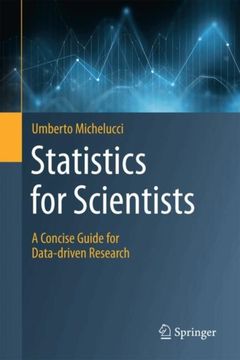
Statistics for Scientists. A Concise Guide for Data-driven Research
Umberto Michelucci
Statistics for Scientists. A Concise Guide for Data-driven Research
Umberto Michelucci (Author) · Springer International Publishing AG · Hardcover
Statistics for Scientists. A Concise Guide for Data-driven Research
Umberto Michelucci
This book offers researchers and practitioners a concise and accessible guide to the essential concepts in statistics, emphasizing their proper application. It encourages readers to delve deeper into the fascinating field of statistics, a branch of mathematics that enhances our understanding of the world around us. Designed to provide enough material for a short introductory course, Statistics for Scientists caters to students at all levels. It emphasizes real-world applications, providing scientists with the tools they need to conduct more reliable and valid studies, ultimately contributing to the advancement of scientific knowledge. Learn to interpret statistical results accurately and draw meaningful conclusions from your data, significantly contributing to the advancement of scientific knowledge.
Structured to deliver a clear overview of statistics and data analysis for scientific research, the book begins with fundamental concepts, including random variables, outcome spaces, and the distinction between descriptive and inferential statistics. It then explores data types, measures of central tendency, dispersion, and position. The discussion continues with an examination of outliers and various methods for identifying them. As the chapters progress, more complex topics such as distributions, hypothesis testing, and regression analysis are introduced in a step-by-step manner. This structure makes the book suitable for readers ranging from beginners to those seeking a quick refresher.
The author has selected key concepts that anyone interested in using statistics should be familiar with. Some topics, such as hypothesis testing, are covered briefly; a more comprehensive treatment would require a stronger background in statistics and mathematics (such as calculus). With pedagogical elements that include text boxes with Definitions, Examples, and Warnings, this book introduces the necessary concepts of statistics for scientists described in a short and concise way, enriched with tips and rigorous explanations. This book is an invaluable resource for scientists seeking to improve their data analysis skills and contribute to the growing body of scientific knowledge through rigorous and reliable research.
Do you have a question about the book? Login to be able to add your own question.