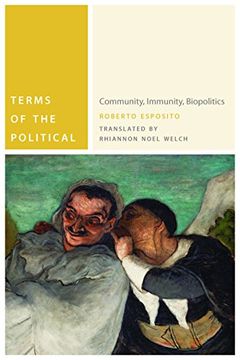
Terms of the Political: Community, Immunity, Biopolitics (Commonalities)
Roberto Esposito
Synopsis "Terms of the Political: Community, Immunity, Biopolitics (Commonalities) "
Terms of the Political: Community, Immunity, Biopolitics presents a decade of thought about the origins and possibilities of political theory from one of contemporary Italy’s most prolific and engaging political theorists, Roberto Esposito. He has coined a number of critical concepts in current debates about the past, present, and future of biopolitics―from his work on the implications of the etymological and philosophical kinship of community (communitas) and immunity (immunitas) to his theorizations of the impolitical and the impersonal.Taking on interlocutors from throughout the Western philosophical tradition, from Aristotle and Augustine to Weil, Arendt, Nancy, Foucault, and Agamben, Esposito announces the eclipse of a modern political lexicon―“freedom,” “democracy,” “sovereignty,” and “law”―that, in its attempt to protect human life, has so often produced its opposite (violence, melancholy, and death). Terms of the Political calls for the opening of political thought toward a resignification of these and other operative terms―such as “community,” “immunity,” “biopolitics,” and “the impersonal”―in ways that affirm rather than negate life.An invaluable introduction to the breadth and rigor of Esposito’s thought, the book will also welcome readers already familiar with Esposito’s characteristic skill in overturning and breaking open the language of politics.
Roberto Esposito, nacido el 4 de agosto de 1950 en Piano di Sorrento, Italia, es un filósofo contemporáneo destacado en el ámbito de la filosofía política y la teoría crítica. Es reconocido por sus estudios sobre biopolítica y por haber desarrollado conceptos clave que exploran la relación entre la vida, la comunidad y la política. Su carrera académica se ha desarrollado principalmente en la Scuola Normale Superiore de Pisa, donde ha enseñado filosofía teórica, y ha tenido influencia internacional en la reflexión sobre el poder y la sociedad contemporánea. Entre sus aportes más importantes se encuentra la reinterpretación de nociones como communitas e immunitas. La primera no se entiende como una comunidad tradicional, sino como una experiencia de compartir y exponerse a lo común, mientras que la segunda representa la lógica de protección que, al separarse de lo común, puede volverse autodestructiva. A partir de estas ideas, Esposito analiza cómo la vida política y la biológica se entrelazan, planteando que los mecanismos de protección social y política pueden derivar en procesos que ponen en riesgo aquello que buscan preservar. Su obra ha renovado la reflexión sobre la democracia, la vulnerabilidad, la gestión de la vida y las relaciones entre individuo y colectivo. Con un enfoque que conecta filosofía, política y ética, Esposito se ha consolidado como una de las voces más influyentes para comprender los desafíos del mundo contemporáneo.