Hallo! Tracked shipping to Netherlands with Delivery Duty Paid for just €7 

Ship to
Netherlands
0
  • argentina
  • chile
  • colombia
  • españa
  • méxico
  • perú
  • estados unidos
  • internacional

Select your country

Americas

Europe

Rest of the world

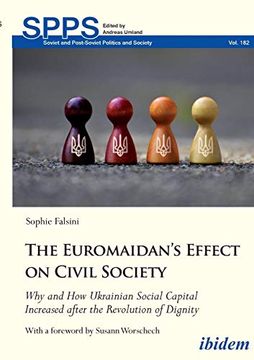
portada The Euromaidan’S Effect on Civil Society: Why and how Ukrainian Social Capital Increased After the Revolution of Dignity (Soviet and Post-Soviet Politics and Society)
Type
Physical Book
Publisher
Year
2018
Language
English
Pages
160
Format
Paperback
ISBN13
9783838211312

The Euromaidan’S Effect on Civil Society: Why and how Ukrainian Social Capital Increased After the Revolution of Dignity (Soviet and Post-Soviet Politics and Society)

Sophie Falsini (Author) · Ibidem · Paperback

The Euromaidan’S Effect on Civil Society: Why and how Ukrainian Social Capital Increased After the Revolution of Dignity (Soviet and Post-Soviet Politics and Society) - Sophie Falsini

New Book Imported to Netherlands
Delivery: 14 Aug - 18 Aug Shipping: 4 to 5 business days.
€ 31,76
Import costs and 9% BTW included in the price ✅
€ 31,76

Synopsis "The Euromaidan’S Effect on Civil Society: Why and how Ukrainian Social Capital Increased After the Revolution of Dignity (Soviet and Post-Soviet Politics and Society) "

Sophie Falsini presents a fascinating analysis of the current state and future prospects of Ukrainian civil society in light of the 2013–2014 events. Since then, the country has been shaken by both sociopolitical disorders and a deep humanitarian emergency, also exacerbated by the crisis of internally displaced people. Yet it is under these same premises that civil society emerged as a main actor in post-Euromaidan politics, development, and reform. Through its war relief work and the endeavors to lead Ukraine towards democratization, civil society has, to a considerable degree, offset the lack of an efficient state administration and activated vital components of Ukrainian social capital.Falsini explores the way and the extent to which the events occurring in Ukraine since late 2013―the Euromaidan revolution, the annexation of Crimea, and the war in the East―have contributed to the growth of social capital as well as to the resulting change in the shape and in the structure of civil society in the country. Through a multidimensional approach, combining theoretical interpretation with empirical analysis, the study examines Ukraine’s transformed civil society in terms of its social relations, societal networks and resources, and collective action. Based on the theory of social capital after Lin Nan, the empirical analysis revolves around the case studies of 12 civil society organizations active in providing help to internally displaced people. Semi-structured interviews were conducted in Kiev, Dnipro, and Kharkiv aiming to confirm or discard the thesis of a post-Euromaidan civil society powered by increased levels of social capital.The collected data show that the 2013–2014 events did indeed contribute to the reshaping of the structure of Ukrainian civil society as they reversed people’s preference for informal and cross-level networks, mistrust towards the system, and disappointment with public institutions. Compared to the past, Ukraine’s "civil society 2.0" saw the rise of grassroots and voluntary movements which triggered social mobilization, and a long-term investment of resources for the benefit of the public good. These developments have significantly contributed to an increase of the level of social capital in post-Euromaidan Ukraine.

Customers reviews

Frequently Asked Questions about the Book

All books in our catalog are Original.
The book is written in English.
The binding of this edition is Paperback.

Questions and Answers about the Book

Do you have a question about the book? Login to be able to add your own question.

Opinions about Bookdelivery

More customer reviews