Tracked shipping to the Netherlands for just €3.99. Prices include 9% BTW. 

Ship to
Netherlands
0
  • argentina
  • chile
  • colombia
  • españa
  • méxico
  • perú
  • estados unidos
  • internacional

Select your country

Americas

Europe

Rest of the world

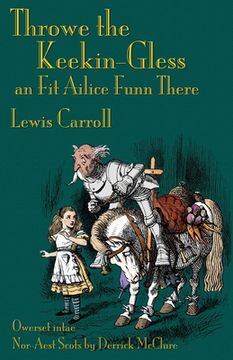
portada Throwe the Keekin-Gless an fit Ailice Funn There: Through the Looking-Glass in North-East Scots (Doric) (in Escocés)
Type
Physical Book
Illustrated by
Translated by
Publisher
Year
2021
Language
Escocés
Pages
172
Format
Paperback
Dimensions
21.6 x 14.0 x 1.0 cm
Weight
0.23 kg.
ISBN13
9781782012559

Throwe the Keekin-Gless an fit Ailice Funn There: Through the Looking-Glass in North-East Scots (Doric) (in Escocés)

Lewis Carroll (Author) · John Tenniel (Illustrated by) · Derrick McClure (Translated by) · Evertype · Paperback

Throwe the Keekin-Gless an fit Ailice Funn There: Through the Looking-Glass in North-East Scots (Doric) (in Escocés) - Lewis Carroll

New Book Imported to Netherlands
Delivery: 02 Jul - 06 Jul Shipping: 5 to 6 business days.
21,36 €
Import costs and 9% BTW included in the price ✅
21,36 €

Synopsis "Throwe the Keekin-Gless an fit Ailice Funn There: Through the Looking-Glass in North-East Scots (Doric) (in Escocés)"

For a general introduction to the literary and cultural background of the present translation, and to the North-East Scots dialect itself, see the introduction to my translation of Carroll's previous book, Ailce's Anters in Ferlielann. As there, I have used a conservative form of the dialect, checking the words and pronunciations against classic literary texts (and this time also against the earlier translation, to ensure consistency). As there too, I have endeavoured to find a specific equivalent for every joke, pun, allusion and other trick of style in the original. The metrical and rhyme patterns of the poems are maintained: as always in poetic translations of any kind, this procedure necessitates some departures from the original wording; and in one instance, namely the sequence of thirteen rhymes on "toe" in the closing section of the White Knight's song, I have assumed the licence to treat Carroll's lines with complete freedom. Puns and other forms of word-play appear at corresponding places to those in the source book: this too necessarily entails departure from the original wording, as in the Midgie's (Carroll's Gnat's) "Somethin about a haverin aiver, ye ken" to replace "Something about 'horse' and 'hoarse', you know". Culture-bound allusions are replaced with ones more readily associated with the expected new readership (his Anglo-Saxon messengers with their Anglo-Saxon attitudes becoming Pictish messengers with Pictish poseitions); and a clearly-differentiated speech-form, namely the Clydeside basilect, is again used for characters whose dialogue in the original suggests non-standard English (the Frog in Chapter IX and the Wasp in the "lost" episode). --Derrick McClure
Lewis Carroll
  (Author)
View Author's Page
Charles Lutwidge Dodgson (Daresbury, Cheshire, United Kingdom; January 27, 1832-Guildford, Surrey, United Kingdom; January 14, 1898), better known in the literary world by his pseudonym Lewis Carroll, was an Anglican deacon, logician, mathematician, photographer, and British writer. He was the eldest son of a large family and raised in a clerical environment, showing from a young age a great ability for mathematics and narrative, giving him the opportunity to enter Oxford, where he served as a mathematics professor for two decades.

Over the years, he became a multifaceted author, cultivating his passion for logic, literature, and photography, disciplines that were very reflected in his literary work.

Although Lewis Carroll did not receive international literary awards during his lifetime, his work was recognized and celebrated from its publication, and his influence has been lasting and global. Alice in Wonderland has been translated into more than 97 languages and has never stopped being published, establishing itself as an essential classic. Additionally, Carroll was a pioneer in the use of logic in children's literature and in the creation of fantastic worlds that challenge narrative conventions.

His most famous works are Alice in Wonderland and its sequel, Through the Looking-Glass and What Alice Found There, in addition to other works such as The Hunting of the Snark or Sylvie and Bruno.
See more
See less

Customers reviews

Frequently Asked Questions about the Book

All books in our catalog are Original.
The book is written in Escocés.
The binding of this edition is Paperback.

Questions and Answers about the Book

Do you have a question about the book? Login to be able to add your own question.

Opinions about Bookdelivery

More customer reviews