Hallo! Tracked shipping to Netherlands with Delivery Duty Paid for just €7 

Ship to
Netherlands
0
  • argentina
  • chile
  • colombia
  • españa
  • méxico
  • perú
  • estados unidos
  • internacional

Select your country

Americas

Europe

Rest of the world

portada Vector Analysis for Computer Graphics
Type
Physical Book
Publisher
Language
English
Pages
246
Format
Paperback
Dimensions
23.4 x 15.6 x 1.4 cm
Weight
0.37 kg.
ISBN13
9781447175070
Edition No.
0002

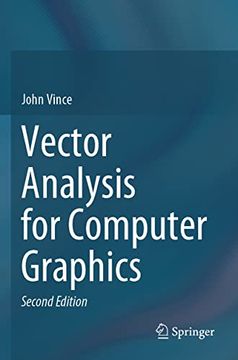
Vector Analysis for Computer Graphics

John Vince (Author) · Springer · Paperback

Vector Analysis for Computer Graphics - Vince, John

Cheaper New Book Imported to Netherlands
Delivery: 02 Sep - 09 Sep Shipping: 12 to 16 business days.
€ 54,17
Faster New Book Imported to Netherlands
Delivery: 20 Aug - 24 Aug Shipping: 4 to 5 business days.
€ 69,13
Import costs and 9% BTW included in the price ✅
€ 54,17

Synopsis "Vector Analysis for Computer Graphics"

In my last book, Geometry for Computer Graphics, I employed a mixture of algebra and vector analysis to prove many of the equations used in computer graphics. At the time, I did not make any distinction between the two methodologies, but slowly it dawned upon me that I had had to discover, for the first time, how to use vector analysis and associated strategies for solving geometric problems. I suppose that mathematicians are taught this as part of their formal mathematical training, but then, I am not a mathematician! After some deliberation, I decided to write a book that would introduce the beginner to the world of vectors and their application to the geometric problems encountered in computer graphics. I accepted the fact that there would be some duplication of formulas between this and my last book; however, this time I would concentrate on explaining how problems are solved. The book contains eleven chapters: The first chapter distinguishes between scalar and vector quantities, which is reasonably straightforward. The second chapter introduces vector repres- tation, starting with Cartesian coordinates and concluding with the role of direction cosines in changes in axial systems. The third chapter explores how the line equation has a natural vector interpretation and how vector analysis is used to resolve a variety of line-related, geometric problems. Chapter 4 repeats Chapter 3 in the context of the plane.

Customers reviews

Frequently Asked Questions about the Book

All books in our catalog are Original.
The book is written in English.
The binding of this edition is Paperback.

Questions and Answers about the Book

Do you have a question about the book? Login to be able to add your own question.

Opinions about Bookdelivery

More customer reviews