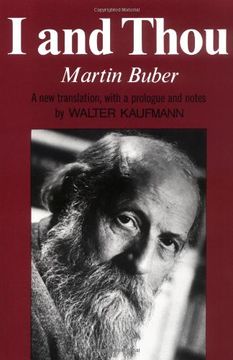
100 years after its original publication, Martin Buber's landmark work of philosophy and theology I and Thou remains one of the most important books of Western thought and a seminal work of 20th-century intellectual history. Considered to be one of the most influential books of Western thought since its original publication in 1923, Martin Buber's slender volume I and Thou influenced the way we think about our relationships with one another and with God. Buber unites currents of modern German philosophy with the Judeo-Christian tradition, powerfully updating faith for modern times. I and Thou is Martin Buber's pioneering work and the centerpiece of his groundbreaking philosophy. In it, Buber--one of the greatest Jewish minds of the 20th century--lays out a view of the world in which human beings can enter into relationships that enhance their mutual existential dignity (I-Thou relations). These "dialogical" relations contrast with those that tend to prevail in modern society, namely the treatment of others as objects to advance personal and collective interests (I-It relations). Buber demonstrates how I-Thou interhuman meetings reflect and embody the human meeting with God. For Buber, the essence of biblical religion affirms the possibility of a dialogue between man and God.
Martin Buber fue un filósofo, teólogo y escritor judío de origen austriaco, nacido el 8 de febrero de 1878 en Viena, Austria, y fallecido el 13 de junio de 1965 en Jerusalén. Es conocido principalmente por sus aportes a la filosofía del diálogo y por su pensamiento sobre las relaciones humanas.
Durante su juventud estudió Filosofía, Historia del Arte y Filología en las universidades de Viena, Berlín, Zúrich y Leipzig. A lo largo de su vida se interesó especialmente por el judaísmo, la espiritualidad y la cultura judía. También participó activamente en el movimiento sionista, aunque defendió una visión basada en la cooperación y el diálogo entre judíos y árabes.
Su obra más conocida es Yo y Tú, publicada en 1923. En este libro desarrolló su filosofía del diálogo y distinguió entre dos tipos fundamentales de relación: Yo-Tú, basada en el encuentro auténtico con otra persona, y Yo-Ello, en la que el otro es tratado como un objeto.
En 1938 emigró a Palestina, donde continuó su actividad académica. Fue profesor de Sociología de las Religiones en la Universidad Hebrea de Jerusalén. Su pensamiento influyó en la filosofía, la teología, la psicología y las ciencias sociales, especialmente por su importancia otorgada al diálogo y al encuentro entre las personas.