Hallo! Tracked shipping to Netherlands with Delivery Duty Paid for just €7 

Ship to
Netherlands
0
  • argentina
  • chile
  • colombia
  • españa
  • méxico
  • perú
  • estados unidos
  • internacional

Select your country

Americas

Europe

Rest of the world

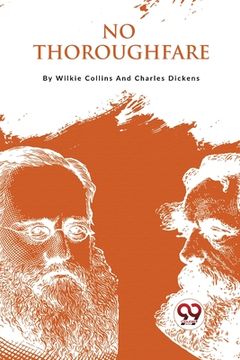
portada No Thoroughfare
Type
Physical Book
Language
English
Pages
132
Format
Paperback
Dimensions
22.9x15.2x0.8 cm
Weight
0.20 kg.
ISBN13
9789357279017

No Thoroughfare

Charles Dickens (Author) · Wilkie Collins (Author) · Double 9 Booksllp · Paperback

No Thoroughfare - Charles Dickens

New Book Imported to Netherlands
Delivery: 10 Sep - 14 Sep Shipping: 2 to 3 business days.
€ 16,77
Import costs and 9% BTW included in the price ✅
€ 16,77

Synopsis "No Thoroughfare"

The stage drama and book No Thoroughfare, by Charles Dickens and Wilkie Collins, were both published in December 1867. No Thoroughfare: A Drama: In Five Acts was a theatre drama written in 1867 by Charles Dickens and Wilkie Collins. Previously, the two had worked together on the play The Frozen Deep. Dickens' final stage production was this one; he passed away in June 1870. On December 26, 1867, the drama had its premiere at the Adelphi Theatre. The first edition of Dickens' book No Thoroughfare appeared in the Christmas issue of his magazine All the Year Round in 1867. Other books from Dickens's mature writings, like Little Dorrit (1857) and Our Mutual Friend, have similar themes to this one (1865). An early instance of commercial merchandising, the story's publication in All The Year Round promoted both the play to those who had read the book and the story to those who were aware of the theatrical production. The book's chapters, which are referred to as "acts," correspond to the scenes in the play. The narrative includes skillfully worded descriptions, diverse and well-drawn people, unsettling and exotic settings, mystery, partially revealed identities, near-death experiences, romance, and the ultimate triumph of Good over Evil.
Charles Dickens
  (Author)
View Author's Page
Charles Dickens (February 7, 1812 - June 9, 1870) was born in Portsmouth and was the eldest son of a Royal Navy clerk. At twelve, his father's imprisonment for debt forced him to work in a blacking factory. His education was sporadic: he taught himself shorthand, worked as a clerk in a law office, and eventually became a parliamentary correspondent for the Morning Chronicle.

Coming from a humble family, "good old Charles" did not receive formal education until he was nine, and was heavily criticized by the critics of the time for being too self-taught. His life took an unexpected turn with his father's imprisonment for debts, moving his family to live with him in jail, allowed at that time by British laws. At the age of 12, he was already considered fit to start working in a dye factory. Although his family's situation had improved, his mother insisted he keep working there, inspiring him to write one of his masterpieces, David Copperfield.

His articles, later collected in Scenes from London Life by "Boz" (1836-1837), were very successful, and with the appearance in 1837 of The Posthumous Papers of the Pickwick Club, Dickens became a true publishing phenomenon. Novels such as Oliver Twist (1837-1839), Nicholas Nickleby (1838-1839), and Barnaby Rudge (1841) gained enormous popularity, as did some travel chronicles, such as Pictures from Italy (1846). With Dombey and Son (1846-1848) he began his mature period, of which good examples are David Copperfield (1849-1850), his first novel in the first person and his favorite, in which he developed some autobiographical episodes; Bleak House (1852-1853); Little Dorrit (1855-1857), A Tale of Two Cities (1859), Great Expectations (1860-1861), and Our Mutual Friend (1864-1865). He died at Gad's Hill, his country house in Higham, in the county of Kent.
See more
See less
Wilkie Collins
  (Author)
View Author's Page
(London 1824-1889) Playwright, novelist, and prolific short story writer. At 17, he started working at a tea trading company while writing Ioláni, or Tahiti as it was (Gothic no. 32), a work that was not published until over a century after his death. He studied Law and, although he never practiced, he did use his legal knowledge in many of his works, and critics consider him one of the fathers of the detective genre. In 1851, he met Charles Dickens, with whom he formed a deep friendship and published his main works in his weekly All the Year Around. After Dickens' death in 1870, his popularity waned. He suffered from rheumatic gout which eventually led to an opium addiction. His tombstone epitaph highlights him as the author of the novel The Woman in White.
See more
See less

Customers reviews

Frequently Asked Questions about the Book

All books in our catalog are Original.
The book is written in English.
The binding of this edition is Paperback.

Questions and Answers about the Book

Do you have a question about the book? Login to be able to add your own question.

Opinions about Bookdelivery

More customer reviews