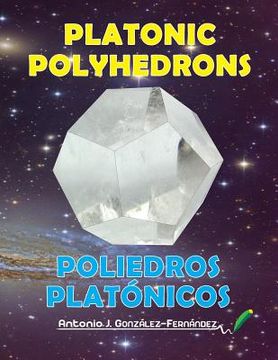
In three-dimensional geometry, a platonic solid is a convex regular polyhedron, made up of several regular and equal polygons in shape and size, therefore all sides are identical, all angles between edges are equal and the length of all its edges are constant. There are only five perfect regular polyhedrons known as the Platonic Solids because the Greek philosopher Plato (427 -347 BC) was who studied them thoroughly and described them for science. They are: the tetrahedron (with 4 vertices, 6 edges and 4 triangular facets), the hexahedron or cube (with 8 vertices, 12 edges and 6 square facets), the octahedron (with 6 vertices, 12 edges and 8 triangular facets), the dodecahedron (with 20 vertices, 30 edges and 12 pentagonal facets) and the icosahedron (with 12 vertices, 30 edges and 20 triangular facets). In this booklet you will find formulas to calculate the main dimensions of each of the Platonic solids or polyhedrons: the height, the surfaces of each facets and total, the total volume and the radius of the circumscribed, inscribed and middle spheres. Also find some pages to trim and build solids that can serve for educative purposes for children and youth or for decoration in your desk or library.-------------------------------- En geometría tridimensional, un poliedro o un sólido platónico es un poliedro regular convexo, conformado por varios polígonos regulares e iguales en forma y tamaño, por lo tanto, todas sus caras son idénticas, todos sus ángulos entre aristas son iguales y la longitud de todas sus aristas es constante. Existen solamente cinco poliedros regulares perfectos, conocidos como sólidos platónicos porque fue el filósofo griego Platón (427 - 347 AC) quien los estudió a fondo y los describió para la ciencia. Son ellos: el tetraedro (con 4 vértices, 6 aristas y 4 caras triangulares), el hexaedro o cubo (con 8 vértices, 12 aristas y 6 caras cuadradas), el octaedro (con 6 vértices, 12 aristas y 8 caras triangulares), el dodecaedro (con 20 vértices, 30 aristas y 12 caras pentagonales) y el icosaedro (con 12 vértices, 30 aristas y 20 caras triangulares).En este folleto vas a encontrar las fórmulas para calcular las principales dimensiones de cada uno de los sólidos o poliedros platónicos: la altura, la superficie de cada una de sus caras, la superficie total del sólido, el volumen y los radios de las esferas circunscrita, inscrita y medial. También encontrarás algunas páginas para recortar y construir los sólidos que pueden servir con fines educativos para niños y jóvenes o para adorno en un escritorio o biblioteca.