Hallo! Tracked shipping to Netherlands with Delivery Duty Paid for just €7 

Ship to
Netherlands
0
  • argentina
  • chile
  • colombia
  • españa
  • méxico
  • perú
  • estados unidos
  • internacional

Select your country

Americas

Europe

Rest of the world

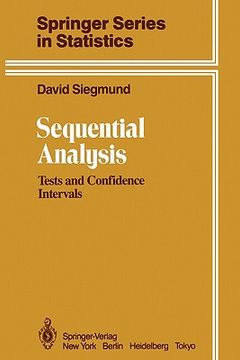
portada sequential analysis: tests and confidence intervals
Type
Physical Book
Publisher
Year
2010
Language
English
Pages
274
Format
Paperback
Dimensions
23.4 x 15.6 x 1.5 cm
Weight
0.41 kg.
ISBN
1441930752
ISBN13
9781441930750

sequential analysis: tests and confidence intervals

David Siegmund (Author) · Springer · Paperback

sequential analysis: tests and confidence intervals - Siegmund, David

Cheaper New Book Imported to Netherlands
Delivery: 07 Sep - 14 Sep Shipping: 13 to 17 business days.
€ 122,93
Faster New Book Imported to Netherlands
Delivery: 25 Aug - 27 Aug Shipping: 5 to 6 business days.
€ 163,50
Import costs and 9% BTW included in the price ✅
€ 122,93

Synopsis "sequential analysis: tests and confidence intervals"

The modern theory of Sequential Analysis came into existence simultaneously in the United States and Great Britain in response to demands for more efficient sampling inspection procedures during World War II. The develop- ments were admirably summarized by their principal architect, A. Wald, in his book Sequential Analysis (1947). In spite of the extraordinary accomplishments of this period, there remained some dissatisfaction with the sequential probability ratio test and Wald's analysis of it. (i) The open-ended continuation region with the concomitant possibility of taking an arbitrarily large number of observations seems intol- erable in practice. (ii) Wald's elegant approximations based on "neglecting the excess" of the log likelihood ratio over the stopping boundaries are not especially accurate and do not allow one to study the effect oftaking observa- tions in groups rather than one at a time. (iii) The beautiful optimality property of the sequential probability ratio test applies only to the artificial problem of testing a simple hypothesis against a simple alternative. In response to these issues and to new motivation from the direction of controlled clinical trials numerous modifications of the sequential probability ratio test were proposed and their properties studied-often by simulation or lengthy numerical computation. (A notable exception is Anderson, 1960; see III.7.) In the past decade it has become possible to give a more complete theoretical analysis of many of the proposals and hence to understand them better.

Customers reviews

Frequently Asked Questions about the Book

All books in our catalog are Original.
The book is written in English.
The binding of this edition is Paperback.

Questions and Answers about the Book

Do you have a question about the book? Login to be able to add your own question.

Opinions about Bookdelivery

More customer reviews