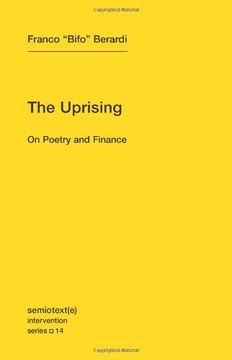
A manifesto against the concepts of growth and debt, and a call for a reinvestment in the social body.The Uprising is an Autonomist manifesto for today's precarious times, and a rallying cry in the face of the catastrophic and irreversible crisis that neoliberalism and the financial sphere have established over the globe. In his newest book, Franco "Bifo" Berardi argues that the notion of economic recovery is complete mythology. The coming years will inevitably see new surges of protest and violence, but the old models of resistance no longer apply. Society can either stick with the prescriptions and "rescues" that the economic and financial sectors have demanded at the expense of social happiness, culture, and the public good; or it can formulate an alternative. For Berardi, this alternative lies in understanding the current crisis as something more fundamental than an economic crisis: it is a crisis of the social imagination, and demands a new language by which to address it.This is a manifesto against the idea of growth, and against the concept of debt, the financial sector's two primary linguistic means of manipulating society. It is a call for exhaustion, and for resistance to the cult of energy on which today's economic free-floating market depends. To this end, Berardi introduces an unexpected linguistic political weapon--poetry: poetry as the insolvency of language, as the sensuous birth of meaning and desire, as that which cannot be reduced to information and exchanged like currency. If the protests now stirring about the world are to take shape and direction, then the revolution will be neither peaceful nor violent--it will be linguistic, or will not be at all.
Franco “Bifo” Berardi (nacido en Bolonia en 1949) es un filósofo, escritor y agitador cultural italiano muy influyente dentro del movimiento autonomista. Se formó en estética en la Universidad de Bolonia y participó activamente en el movimiento estudiantil de 1968. Durante los años 70, fue fundador de la revista A/Traverso y cofundador de Radio Alice, la primera emisora pirata de Italia, clave en el activismo mediático de la época. También fue parte del grupo Potere Operaio y vivió en París tras ser perseguido durante la represión estatal, donde encontró influencias intelectuales de Félix Guattari. Más adelante, pasó tiempo en ciudades como Nueva York y San Francisco.
Hoy enseña historia social de la comunicación en la Academia de Bellas Artes de Brera, en Milán, y ha sido pionero en movimientos como TV Orfeo, la primera televisión comunitaria italiana. Como ensayista, ha publicado decenas de libros en diversos idiomas, abordando temas como el trabajo, la comunicación, la alienación, la psicopolítica y los efectos del capitalismo posindustrial.
Es autor de obras destacadas como La fábrica de la infelicidad, Generación post-alfa, Fenomenología del fin, La sublevación, El umbral y La segunda venida, entre muchas otras. Su pensamiento combina crítica cultural, análisis del trabajo y propuestas poéticas y subjetivas para enfrentar el semiocapitalismo moderno.